








Castles, caves and cable cars: One family's kid-friendly, budget adventure
Jessica Hill
8 April 2026
When I told people that my partner and I were taking our three boisterous young boys (then aged 7, 10 and 10) and a moping 18 year old (who is generally wary about visiting new places) with us on an Interrailing adventure across Europe, they all thought I was bonkers.
Especially when I revealed that we would not be allowing the boys on any type of screen during that time.
There is a widely held perception that once globetrotting adventurers settle down and make babies, their days of backpacking are over — at least until their offspring have flown the nest and they can go off on their own. But it doesn’t have to be that way.
Interrailing nurtures a spirit of adventure in children that will (hopefully) last a lifetime. It encourages you to bond together as a family in a way that makes the average package holiday seem rather dull in comparison.
Yet planning is key when it comes to kid-friendly travel. My aim was not simply to follow the well-trodden tourist trail and tick off the big capital cities, but to create an itinerary that would showcase Europe’s natural wonders as much as its architectural masterpieces, avoid the crowds where possible and keep within a reasonably tight budget.
Before we set off last May, our children only ever been abroad once before, and the furthest they had ever been on a train was the 110 kilometres from our home in Ipswich to London for the day. Their sense of excitement as we boarded the Eurostar at St Pancras Station was comparable to three Christmas Eves all rolled into one, with just a tinge of trepidation.
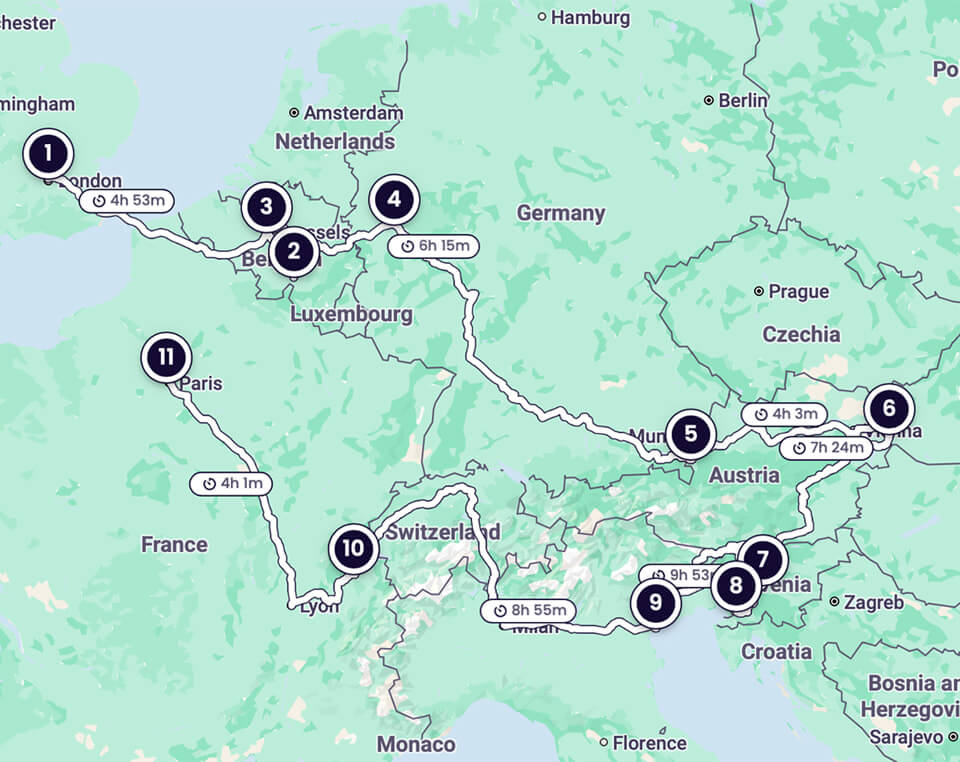
Visiting eight countries across 11 days was a rollercoaster-ride of a holiday. I would suggest taking at least 14 days for this trip, if you can.
Total expenses across 11 days:
- Accommodation: €1,878
- Passes: €1,229
- Food and drinks: €1,055
- Attractions: €861
- Seat reservations: €630
- Total: €5,653
-
Interrail Global Pass
-
10 days within 2 months


- London, Great Britain 🇬🇧
- Dinant, Belgium 🇧🇪
- Brussels, Belgium (afternoon visit) 🇧🇪
- Cologne, Germany (afternoon visit) 🇩🇪
- Salzburg, Austria 🇧🇪
- Bratislava, Slovakia 🇸🇰
- Ljubljana, Slovenia (afternoon visit) 🇸🇮
- Divača, Slovenia 🇸🇮
- Venice, Italy (afternoon visit) 🇮🇹
- Geneva, Switzerland 🇨🇭
- Paris, France 🇫🇷
- London, Great Britain 🇬🇧
Trip details

An imposing citadel perches over Dinant
Dinant, Belgium
Why it's worth visiting with kids:
After leaving London, our first stop was a little-known, strikingly picturesque Belgian town, with colourful waterfront buildings and an onion-shaped church dome set against a steep cliff backdrop.
Dinant is small enough to spend a day meandering, taking a funicular up to its citadel peak or boating along the river, with all the main sites within a 15-minute walk of each other and the station.
What to do:
- Quaint Dinant celebrates its status as the birthplace of the inventor of the saxophone, Adolphe Sax, with 60 giant, brightly decorated saxophones dotted about town. Mr. Sax’s House is also free and worth a quick visit.
- My boys loved the cable car ride to the citadel perched on a rock, offering sweeping views across the town. There, you can also learn all about the town’s grim military history. Be warned: the citadel’s museum has a replica First World War trench with a sloping floor designed to give you a sense of the vertigo that soldiers must have felt —it really does make you queasy. After spending time at the citadel’s playground, our boys dared each other to descend the 408 stairs back down the clifftop.
- Afterwards, I thoroughly recommend trying the traditional Couque de Dinant (rock-hard honey cakes) from the nearby Coques Jacobs patisserie, which also sells the best hot chocolate I’ve ever had.
- The region around Dinant is full of caves and one, La Marveilleuse, is just a ten-minute walk from the train station — well worth a visit before you leave town.
- If you have more than a day and older-age kids, Dinant Evasion’s adventure park just outside the town centre makes the most of the area’s green canyons for rock climbing, high ropes and zip-lining activities. You can also take a river cruise or hire an electric boat to sail along the River Meuse.
Sample expenses:
- Seat reservations from London to Brussels (to reach Dinant): €252
- Riverside ‘Le Franchet’ flat in Dinant for one night: €158
- Citadel tickets: €78
- Food (pasta cooked in flat and hot chocolate and cakes in a cafe): €70
Suggested route
-
From: Dinant
-
To: Bruxelles-Central
-
Average travel time: 1 hours, 45 minutes
-
Transfers: 1
-
Seat reservations: Not required


Tintin-themed street art can be found across Brussels
Brussels, Belgium
Why it's worth visiting with kids:
Brussels is perfect for families with fussy eaters, as its local cuisine includes lots of what everyone loves; chocolate, Belgian waffles and chips. It’s also great for fans of Belgian comic strip icons like Tintin, Astérix and The Smurfs. We only had a few hours to spend there but found lots to see within a short walk of Brussels Central Station.
What to do:
- No trip to Brussels would be complete without taking in the Gothic wonders of its iconic square, Grand Place, where the sight of a newly married couple waving from a balcony of the Maison Grand Place cheered our spirits as the rain poured down.
- There were cheeky laughs from the boys at the sight of the nearby Manneken Pis. Also in the area is Galeries Royales Saint Hubert, the world’s oldest shopping arcade and great for sampling chocolate delights.
- At the tourist information centre at Grand Place, you can pick up a map for the five-kilometre Comic Strip Route, which takes you past an array of quirky murals, the city’s Comic Art Museum and many key heritage sites.
Sample expenses:
- Food (waffles): €110
Suggested route
-
From: Bruxelles-Nord
-
To: Koeln Hbf
-
Average travel time: 1 hours, 41 minutes
-
Transfers: 0
-
Seat reservations: Not required

Cologne Cathedral, located just beside the train station, is a convenient stop for Interrailers
Cologne, Germany
Why it's worth visiting with kids:
Cologne is ideal for a short stopover, as there is so much to see and do within a half hour walk of its main train station, including its iconic cathedral (one of Germany’s most visited landmarks), an old town painstakingly rebuilt after the war and stunning views from Koln Triangle’s observation deck.
Our enjoyment of the city was dampened by a seemingly never-ending torrential downpour of rain, testing everybody’s inner resilience and the waterproof resilience of our coats in equal measure. It was also where my fear – that our overnight train would be delayed and we would be forced to while away hours sitting on a station floor – came true. Thankfully, the children had the time of their lives playing games of ‘who can jump high enough to hit the overhead sign’ and watching all the frantic people sprinting to make the last train home. I came to appreciate just how brilliant train stations are for people-watching, and when we did finally get on our overnight train to Munich (and then on to Salzburg), the kids fell asleep almost immediately.
What to do:
Cologne Cathedral, across the street from the station, is a sight to behold, with its gilded shrine said to contain the remains of the Biblical Magi (three wise men) and high altar made of black marble. If you can manage the 533 steps to the top of the cathedral tower, you can pass by its giant bells up close and enjoy panoramic views over the city.
- Our boys enjoyed trying to spot the oldest dates etched onto the love locks left along the massive steel Hohenzoller Bridge that crosses the River Rhine, before they came to realise later in the trip that lovelocks are now ubiquitous in many tourism hotspots.
- Just across the water is the Koln Triangle skyscraper, with an observation deck which costs €5 to visit. Our boys also enjoyed splashing about in the Paolozzi Fountain complex along the banks of the Rhine (they were already soaking wet from the rain, anyway).
- We appreciated the frankfurters at Brauhaus Sion, a family-friendly German beer hall complete with a display of mannequins in festive costumes.
Sample expenses:
- Koln Triangle tickets: €30
- Food (restaurant meal): €150
Suggested route
-
From: Koeln Hbf
-
To: Salzburg Hbf
-
Average travel time: 6 hours, 18 minutes
-
Transfers: 1
-
Seat reservations: Not required

Fortress Hohensalzburg looms overtop Salzburg's old town
Salzburg, Austria
Why it's worth visiting with kids:
As an intrepid teenager on my first European backpacking adventure (which mainly involved bar crawls around big cities), Salzburg stuck in my mind as a special place. And not just because it was the setting for The Sound of Music, one of the only video tapes my family owned.
This time around, it did not disappoint, despite the rainclouds that followed us to Austria.
Though it retains the feel of a small, historic town, there is so much for families to do in and around Salzburg come rain or shine, from hearing nuns chant in ancient monasteries to seeing Formula One cars up close at Red Bull Hangar-7.
We stayed at the mountaintop Stadtalm Naturfreundehaus hostel, set in a forest park that’s ideal for exploring children to clamber about. Breakfast was serve in a nook in its restaurant that seemed to hang off the cliff edge, with incredible panoramic views over the Hohensalzburg Fortress.
What to do:
- The Hohensalzburg Fortress can be reached from the town centre via a funicular railway. It is well worth a visit, particularly for its delightful marionette museum which features dolls used in productions by the Salzburg Marionette Theatre, one of the world’s oldest puppetry companies. Try to be in the grounds just before midday, when trumpets are sounded from the fortress’s towers.
- From there, it’s a short walk to St Peter’s Church, which has ancient and atmospheric catacombs carved out from the rocks that were featured in The Sound of Music. To get a real feel for the musical spirit of Salzburg (Amadeus Mozart’s hometown) either attend a Mozart concert (held regularly in various venues) or visit Salzburg Cathedral, which holds daily midday concerts in which two organists play each of its seven organs for 30 minutes. It costs just €9 each (and kids are free). Given that 30 minutes is the maximum amount of time our children can sit still listening to music, this worked well for us.
- We also whiled away a couple of rainy hours enjoying the aquarium and lifelike waxwork historic displays at Salzburg’s Museum of Natural History and Technology.
- If we had more time, we would have taken a bus and cable car up to the peak of Untersberg mountain, where you can see across to the Alps. On the way back, you can get the bus to Hellbrun Castle and its comical trick fountains – another popular Sound of Music stop.
- Instead though, we got the train to Werfen (about 55 minutes away), home to the world’s biggest ice caves. This was a real adventure, as reaching these caves involved taking a treacherously steep cable car (which I like to think helped our teenager to conquer his fear of heights) and a scenic hike into the clouds. These caves remain almost completely dark to preserve the natural ice formations, with the guide lighting up its icy structures using the brilliant white glow of magnesium while visitors carry small carbide lamps to see their way ahead. The darkness and eerie light shows really added to everyone’s sense of awe.
Sample expenses:
- Seat reservations from Cologne to Salzburg: €48
- Stadtalm Naturfreundehaus dormitory room for one night: €202
- Salzburg card (granting entrance to most tourist attractions): €149
- Organ concert: €24
- Werfen ice caves: €160
- Restaurant food: €200
Suggested route
-
From: Salzburg Hbf
-
To: Bratislava Hlavna Stanica
-
Average travel time: 3 hours, 59 minutes
-
Transfers: 1
-
Seat reservations: Not required

Devin Castle is an easy day trip from Bratislava
Bratislava, Slovakia
Why it's worth visiting with kids:
Bratislava may not be on the typical tourist trail, but it was a big hit for us with its blend of brutalist architecture, old town charm and surprisingly sci-fi chic element, like its flying-saucer-shaped UFO restaurant.
The kids also loved that our accommodation, Possonium Boutique Apartments, came with a large garden filled with toys, a football goalpost and a friendly resident cat, Cocoa.
What to do:
- It’s not exactly an architectural masterpiece, but the kids absolutely loved playing in the city’s Fountain of Union while we enjoyed some lattes and chill-out time. In addition to Bratislava's iconic blue church and amusing statues (we especially liked the one of a man popping up from a drain), we enjoyed visiting its charming traditional store, Schokocafe Maximilian Delikatessen, which feels like stepping back in time, its shelves lined with Slovakian treats in retro packaging.
- From the shop, we headed back across the Danube to peruse the picturesque grounds of the Bratislava’s castle, from where you can see across to Austria and Hungary. Our teenager George, who travelled across Europe with his skateboard attached to his backpack, made the most of Bratislava’s thriving skateboarding scene, becoming friends with local skaters in the park under the Most SNP bridge.
- If you have time, take a boat ride or bus to Devin Castle perched on a rock at the confluence of the Danube and Morava rivers, forming the border with Austria.
Sample expenses:
- Seat reservations from Salzburg to Bratislava: €18
- Boutique Apartments Possonium for two nights: €252
- UFO restaurant refreshments and entry: €80
- Food (dinner cooked in accommodation): €70
Suggested route
-
From: Bratislava-Petrzalka
-
To: Ljubljana
-
Average travel time: 7 hours, 21 minutes
-
Transfers: 1
-
Seat reservations: Not required

Ljubljana's old town is full of character and colour
Ljubljana, Slovenia
Why it's worth visiting with kids:
Ljubljana, a magnet for digital nomads, has a youthful energy and international feel, its main streets lined with ramen and burger bars alongside local and Italian restaurants (a blessing for fussy kids!).
The elegant bridges that cross its river and boats gliding past its many waterside cafés and terraces draw justified comparisons with Venice, minus the crowds and prices. You can see the influence of Slovenia’s proximity to Italy in the city’s architecture and in the trattorias dotted across Ljubljana.
What to do:
- We only had a few hours in Ljubljana and made the most of the time by experiencing its riverside café culture and visiting its elaborately decorated churches (although I’m not going to pretend my kids weren’t getting tired of churches by that point).
- The funicular up to Ljubljana’s castle is fun if you don’t feel like walking to enjoy the views from the highest point in the city.
- The quirky House of Experiments allows kids to try lying on a bed of nails or blowing giant bubbles. It’s an especially great activity for families if it’s raining.
Sample expenses:
- Restaurant lunch and ice cream: €120
Suggested route
-
From: Ljubljana
-
To: Divaca
-
Average travel time: 1 hours, 50 minutes
-
Transfers: 0
-
Seat reservations: Not required

The Škocjan Caves are under five kilometres from Divača — a short car ride away or roughly an hour's walk
Divača, Slovenia
Why it's worth visiting with kids:
From Divača station, it is possible to walk to the truly jaw-dropping UNESCO-listed Škocjan Caves. Most tourists tend to skip them in favour of the more crowded Postojna Cave, which is also easily accessible by train from Ljubljana and has a tourist train running through it. We’re glad we picked Škocjan, though, for its vast underground voids, roaring waters and towering cliffs which are still relatively untouched by human hands. These caves proved to be the highlight of our entire trip.
What to do:
- It takes a whole day to enjoy Škocjan in its entirety. We began by venturing inside the otherworldly, enormous caves and enjoying traditional Slovenian food in the visitors’ centre.
- You can also take one of several hiking routes around Škocjan’s dramatic dolines (sinkholes) and hair-raising bridges. The trail we chose also took us around a historic village of farm dwellings, complete with a pond filled with writhing snakes and newts – the wildlife pinnacle of our holiday.
- Look out for the magnificent old steam engine parked next to the platforms at Divača station.
Sample expenses:
- Zenja apartment for two nights: €474 euros
- Cave tickets: €90
- Supermarket-bought food, cooked in flat: €25
Suggested route
-
From: Divaca
-
To: Venezia S. Lucia
-
Average travel time: 4 hours
-
Transfers: 2
-
Seat reservations: Not required

A quiet corner of Venice's busy canals
Venice, Italy
Why it's worth visiting with kids:
Venice may conjure up more images of love-struck couples rather than family frolics. But it is one of Europe’s most recognisable and picturesque destinations – and Italy is, of course, a great place to enjoy pizza and gelato.
It’s also one of Europe’s busiest and most expensive places to visit. Public toilets can cost as much as €2 per person. For that reason, we only stayed for four hours; enough time for everyone to appreciate why it’s so special without getting too stressed out by the crowds.
What to do:
- Venice is best enjoyed from the water, and as our group of six was too big to fit in a €70 gondola, we instead took a glamorous wooden speedboat (complete with an driver seemingly straight out of a James Bond film) for the same price. It seemed a more fitting ride for our adrenaline-seeking boys, anyway.
- Venice is an art lovers’ paradise, but if you want to skip the long queues and hefty prices at the city’s museums and galleries, you can see works by celebrated artists for free in some of Venice’s churches.
- Don’t miss visiting Burano Island, with its lace shops and bright houses. There, you can watch glass animals being shaped at the Murano Glass Factory or book a “Secret Itineraries” tour of the Doge’s Palace and its hidden passageways. Or book in advance for a secret itineraries tour of Doge’s Palace.
Sample expenses:
- Seat reservations from Venice to Geneva: €78
- Gondola ride: €70
- Food at restaurant: €130
- Public toilets: €20
Suggested route
-
From: Venezia S. Lucia
-
To: Geneve
-
Average travel time: 9 hours, 47 minutes
-
Transfers: 2
-
Seat reservations: Required

The Jet d'Eau shoots water 140 metres into the air
Geneva, Switzerland
Why it's worth visiting with kids:
Geneva is home to one of the main offices of the United Nations — an inspiring opportunity for kids to see global cooperation in action! It also boasts free public transport for overnight visitors. One day is not enough to see everything, but you may not want to stay for longer than a few days, as Geneva’s also one of Europe’s priciest cities.
What to do:
- Top of my to-do list, if the weather amenable, is taking a swim in the sapphire blue waters of Lake Geneva at Bains des Pâqui and gazing at the massive Jet d’Eau fountain and snowy mountains in the distance. There is also plenty in Geneva to keep kids occupied while they swim, including a climbing wall and slide.
- From the lake, you can take a free bus to the UN’s Palais des Nations and check out the (free) nearby Geneva Botanical Garden with its impressive collection of plants and animal park.
- The city itself is also great for strolling around, and the kids enjoyed the views from the top of the church towers of St Peter’s Cathedral. Traveller tip: If you want to tour the Palais des Nations, book in advance on the 20th of the preceding month.
Sample expenses:
- Seat reservations from Geneva to Paris: €60
- Jade Manotel Hotel for one night: €401
- Restaurant lunch: €100
Suggested route
-
From: Geneve
-
To: Paris Gare De Lyon
-
Average travel time: 3 hours, 14 minutes
-
Transfers: 0
-
Seat reservations: Required

Many Interrail journeys begin and end at Gare du Nord in Paris
Paris, France
Why it's worth visiting with kids:
Paris is packed with parks for children to unleash their energy, as well as kid-friendly museums. Plus, it boasts an iconic landmark (the Eiffel Tower!) that they actually recognise from pictures and may even want to see for themselves.
After an arduous trek across Paris to the top of the hill in Montmartre in, which our kids' whining reached fever pitch, we arrived just in time to hear rapturous cheers and see fireworks exploding across the skyline, as the entire city celebrated local football team Paris Saint-Germain winning the Champions League title. It was a truly magical and unforgettable moment that made us all forget about our aching legs.
What to do:
- We particularly enjoyed walking along the banks of the River Seine from Pont Neuf to Bastille, where there are play platforms, climbing frames and rocks for kids to clamber over.
- Our dinner cruise along the river as the sun was setting was the perfect final chapter of our Interrailing adventure.
- We also recommend the free Jardin des Plantes. Inside, there is a zoo and a range of ticketed museums, including the Galerie de l’Évolution, a natural history museum with thousands of animal specimens.
- Across town in the 19th arrondissement, the Parc des Buttes-Chaumant is worth visiting if you’re staying nearby. It’s quite unlike any other park in Paris, as it was created from an old quarry; it features steep rocky outcrops and tunnels, as well as a waterfall and plenty of grassy areas to enjoy a picnic.
- Tip: Visit Notre Dame Cathedral during one of its services (the times are online) for a sense of the sublime.
Sample expenses:
- Seat reservations from Paris home to London: €252
- Apartment for two nights: €391
- Seine river cruise: €240
- Supermarket picnic lunch and breakfast: €50
Suggested route
-
From: Paris Nord
-
To: London St Pancras Intl
-
Average travel time: 2 hours, 56 minutes
-
Transfers: 0
-
Seat reservations: Required (book in advance)



Scroll to see some of the photos Jessica and her family took during their Interrail adventure across Europe!

Jessica and Chris on the train from Venice to Geneva

The peaks and canyons of the Škocjan Caves Park in Slovenia

The steep drop down to the River Riča in Slovenia

Jessica's view from the boat in Venice

The UFO restaurant in Bratislava

Geneva, surrounded by snow-capped mountains even in the late spring
Meet the writer
Jessica Hill works as an education journalist from her home in Suffolk, with her yellow labrador Pippa normally snoring beside her. But when she's not uncovering the next big school scandal, she's exploring new places (mostly by train) with her partner Chris and their seven children and stepchildren, keen to pass on to them her love of travel and adventure. She previously worked as a freelance travel and features writer in Abu Dhabi and co-wrote a book about the culture of the UAE.

A final word
The train journeys between destinations became cherished memories of our holiday. We never regretted imposing a digital detox on our kids and were impressed by how easily they entertained each other, armed with just a pen and paper, a few small games and lots of newfound creativity. Their imaginations were fired up by all the places they’d seen, and they daydreamed while gazing out of train windows.
Just as memorable as the places we’d visited were the people we’d met while travelling by train — the homesick South Korean student studying engineering in Switzerland, the charismatic Slovakian train conductor who told us legends about a pyramid hidden in a mountain and the kind Slovenian lady who offered me a much-needed lift to a supermarket before it closed. We saw much more of humanity’s virtues than its flaws. Our Interrailing adventure broadened our boys’ horizons, and – I hope – their understanding of what it means to be European.
Change of currency
You cannot change the currency once you have a Pass in your cart. Remove the Pass, and then change the currency on the website header.