











Why a farmers market should be your first stop on any trip
Sukriti Kapoor, Content Writer
22 October 2025

The group at Frieburg im Breisgau's Münstermarkt in April (pictured from the left: Benedikt Budde, Emma Malinova, Claudia Trotter, Sukriti Kapoor, Katy Spratte Joyce, Walter Drayer, Lauren David, Hannah Howard and Emily Cappiello)
I had never heard of a “Market Master” before.
I pictured it as one of those cool dream jobs you always want but never understand how to get, like “chocolate-fountain taster” or “professional book reader at a local library.” Turns out, it’s an important, meaningful role that involves many more details than I had originally imagined.
Earlier this year in April, I had embarked on an Interrail train trip using a Global Pass with a group of journalists across France, Germany and Switzerland in search of food that brought us closer to the hands that grew it. Read more about my experiences in this itinerary.
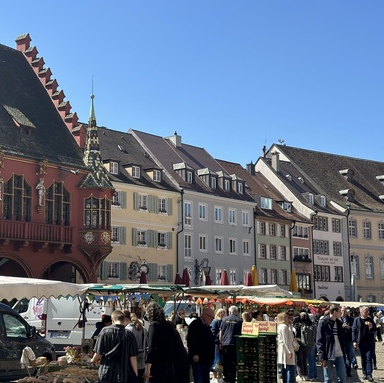
Freiburg im Breisgau's Münstermarkt felt like an essential stop on the trip. Named after the towering Gothic Freiburg cathedral it spawns out from, this farmers market is said to be almost as old as the city itself – going back more than 900 years.

Walter and Ben standing in front of the iconic rust-red Historical Merchant's Hall, located on the corner of the market square
To keep Freiburg’s local economy thriving, the city appointed two Market Masters – Walter Drayer and Kalinga Wijetunga – and Münstermarkt Project Manager “Ben” Benedikt Budde to organise the market, manage the day-to-day operations and publicise and promote it.
“Walter and his colleague Kalinga, they're the two people who run the show... these guys set up this market every day. Every day means 300 days a year,” Ben told us proudly.
As they walked around the market, I saw the connections that the team had built with the sellers – they weren’t just managing the market but sharing lives every morning for the most part of the year. In their busiest season every summer, thousands of people traverse the market every day and I could begin to see why.
The Münstermarkt is open six days a week from Monday to Saturday and represents the soul of Freiburg with around 130 local businesses spread across different sections of the square – from freshly harvested fruits and vegetables to breads just out of the oven, aged alpine cheeses and tart chutneys, Black Forest honey, and artisanal wooden handicrafts.

Fresh fruit and vegetable stalls of the Münstermarkt captured on a warm, sunny summer morning. Credit FWTM Spiegelhalter
The Market Masters play an essential role in protecting and supporting the local family-run businesses in the area. During the pandemic, the market served as the central meeting point for residents and kept that feeling of community going.
Many of the sellers in the market have been in the business for generations, such as one winegrower and fruit farm owner, David Sexauer, whose family has been working the fields in the region since 1860.
"Our strength is – it’s the people that work here,” said Ben. “It's guys like Walter, guys like David, guys like Wolfgang Hassler [one of the Lange Rote stand owners] over there, who's been here for 40 years. Their stories, what they have to tell.”
My little soft spot for farmers markets

An overhead view of the Cours Saleya farmers market in Nice, picturing the colourful striped awnings above the stalls and the pastel-coloured buildings lining the sides
As I walked through the Münstermarkt, I thought about how farmers markets have always felt special to me. As a non-European immigrant who now lives in the Netherlands, my first introduction to Dutch culture was through its farmers markets.
It was a warm but slightly breezy Saturday in Enschede, a city in the far east of the Netherlands, during the summer of 2018 when I first travelled to Europe. It seemed like the whole city was there, picking up their groceries and treating themselves to piping hot stroopwafels and what I consider to be the best fries in the whole world: the Dutch Patat. I was enchanted.
Over time, as I travelled through the Netherlands’ neighbouring countries, I realised that going to farmers markets was perhaps my favourite way of discovering a city and its people. Each time I visit one in a new city, I get this feeling that I could live there – that I could almost belong there.
Like I could grab fresh fruit for breakfast from the Cours Saleya in Nice, or grab a quick on-the-go lunch with some salty aged Gouda cheese and a freshly-baked baguette at the Nieuwmarkt in Amsterdam, or pick the crispiest vegetables for dinner on a walk with a friend as we discuss work, life and love at the Mercado da Vila in Cascais.

My latte order from El Purica in a blue ceramic cup and saucer
That I could live here feeling began to creep in at the start of my visit to the Münstermarkt, when I ordered a latte at El Purica, a café stall that also sells their roasts of Costa Rican coffee beans. And, to my surprise, they served it in a matching blue ceramic cup and saucer that spread its warmth with every sip – and felt a thousand times more special than a standard cardboard to-go cup.
Located at the edge of the Black Forest, Freiburg felt alive in the spring morning sun; its air crisp against my cheeks. Around Münster square stood tall, pastel-coloured buildings carefully watching over the crowds of people crossing the market every day. And amid the commotion of the market and the conversations, the clear-water Bächle that lined the perimeter of the square flowed quietly and continuously.
Claudia and Emma, my colleagues at Eurail who had organised and thoughtfully put this whole trip together, invited Market Master Walter and Project Manager Ben to join us on our Münstermarkt tour and give us a local lens. Ben answered our questions and translated for Walter.
We spoke to them about what goes on behind the scenes, the history of the market, and its importance to the lives of local Freiburgers over the years. As passionate travellers themselves, they also shared their recommendations for first-time visitors to Freiburg and the market and suggestions on how to get the most out of farmers markets in Europe.
What would a Münstermarkt tasting-menu look like?

Ben and Walter pose with the group's Lange Rote sampler – their smiles almost as wide as the sausages

Froh Nat, the vegan dessert and snack stall at the market
We asked Walter and Ben about their three must-haves from the market, and they immediately took us to try the region’s legendary Lange Rote or long red sausage that’s best enjoyed grilled and on a bun with fried onions.
A local favourite, Lange Rote stalls draw huge crowds in mid-week afternoons for on-the-go work lunches, and early on a Saturday morning, when the Friday-night partygoers stop to refuel before heading home.
We then savoured a unique, raw vegan cake from FrohNat made by combining nuts with fresh fruits – the flavour and texture were entirely new to me but still felt familiar, like I was eating a not-too-sweet, just right, mousse cake.
And they recommended Stephan’s famous butter-yellow fluffy cheesecakes made from fresh lemons, cream and quark that I saved for my next visit to the market.

One of the many shops selling white asparagus at the market
We walked past stands with white asparagus neatly lined up like pencils in a back-to-school display at a stationery shop. “The season this year started like three weeks ago,” Ben told me. “It’s really popular. All the German restaurants here will have asparagus during the season. And people really, really eat a lot of asparagus. I hated it when I was a kid, but now I think it's awesome.”
I thought about the okra I disliked eating growing up and how it’s now one of my most-loved Indian dishes. I asked Ben what a typical German preparation of white asparagus looks like, and he fondly said, “You eat it with potatoes, ham, and sauce hollandaise.” It sounded simple, and delicious.
Our next stop was the Steingrubenhof stand where we spoke to Freiburg born-and-raised Isa who practices regenerative agriculture at her family’s farm in the Black Forest. She and her husband Tim are at the Münstermarkt every week because of the strong, direct connection with the people at the market that she calls “the feedback… that gives you back."
We continued our conversation with Isa over a fulfilling cafeteria-style vegetarian lunch at Adelhaus where she told us about her journey from New Zealand back to sustainable growing practices and her hometown.
What should someone visiting Freiburg and the Black Forest do?

A panoramic view of Freiburg and its cathedral from Schlossberg mountain
I asked Ben to design the perfect Freiburg and Black Forest itinerary. “They should come to the Münstermarkt. That should be their first thing,” Ben chimed in. “And then they should go on Schlossberg. That's the mountain.”
Later that day, we took Ben up on his advice and took the cable car up the mountain. The setting sun cast a glow on the city’s skyline that I could not tear myself away from for the most part of our dinner.
Ben’s other picks were Feldberg, the highest mountain in the Black Forest range and Schluchsee, the largest lake in the region. He also recommended mountain biking with several trails around Freiburg.
“You should go hiking. And then you should go to a traditional restaurant after that. And of course, you have to try the famous Black Forest Cherry Cake. It's of several layers. You have like chocolate cake, cream, cherries,” he added. I was sold – as a beginner hiker, any hike that ended in cake sounded like the ideal plan.
What are your tips for navigating farmers markets in Europe?

A variety of cheeses at a Dutch farmers market
“Prepare for where you’re going, what kind of markets you have” and look up opening times before you get there, Ben suggested. While most markets are just open in the mornings, there are some that stay open till late afternoon and many others have fixed opening days.
He went on to tell me about his experiences visiting local markets in Portugal, how each market is so different from the next – some are small and just sell produce and some focus on handicrafts and pre-loved objects. He also highlighted the importance of carrying cash in case a small business owner couldn’t accept cards.
His most important piece of advice: “Always bring time when you go to a market because you shouldn't rush a market. You should really sit down, watch what's happening and never interfere with the Market Master.”
Never interfere with the Market Master. I love that tip.

Meet the writer
Sukriti Kapoor is a writer at Eurail, based in Utrecht, the Netherlands. This spring, she travelled by train to Freiburg im Breisgau and was charmed by the city's fairytale architecture, the energetic Münstermarkt and her insightful conversations with Market Master Walter and Project Manager Ben.
If you liked this article, read about her flavourful adventure across France, Germany and Switzerland in this itinerary.

A little nugget of advice for visiting the Münstermarkt:
Make sure to go as early as possible in the morning and preferably on an empty stomach – Münstermarkt is the best breakfast buffet I encountered on the trip.

Change of currency
You cannot change the currency once you have a Pass in your cart. Remove the Pass, and then change the currency on the website header.